

If you’ve ever opened a brokerage app and stared blankly at the search bar, unsure whether to type in a company ticker or an ETF symbol, you’re not alone. “Should I buy individual stocks or ETFs?” is one of the most common questions new investors ask — and the honest answer is: it depends on what kind of investor you want to be.
This post breaks down the real differences between ETFs and individual stocks, when each one makes sense, and how many experienced investors end up using both.
What’s the Difference, Really?
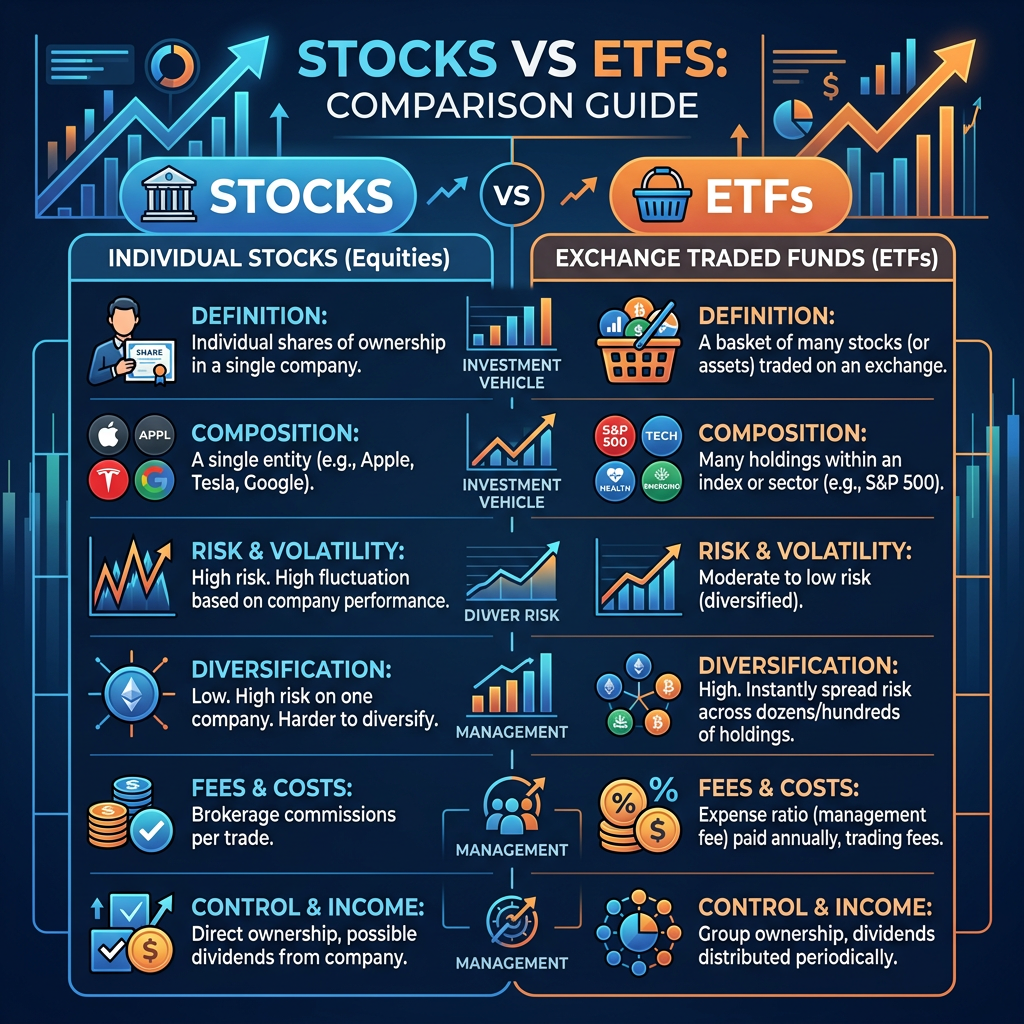
A stock represents ownership in a single company. When you buy shares of Apple or Tesla, you’re betting on that one business — its leadership, its products, its ability to outperform competitors.
An ETF (Exchange-Traded Fund) is a basket of many stocks (or bonds, commodities, etc.) bundled into a single tradeable security. Buy one share of an S&P 500 ETF, for example, and you instantly own a small slice of 500 different companies.
Think of it this way: buying a stock is like betting on one horse in a race. Buying an ETF is like betting on the entire racetrack.
The Case for Individual Stocks
1. Higher upside potential If you pick the right company early, the returns can be extraordinary. Early investors in companies like Amazon or Nvidia saw gains that no diversified fund could have matched.
2. Full control You choose exactly which companies you want exposure to — useful if you have strong convictions about a specific industry or business.
3. No management fees Most stock trades are commission-free today, and there’s no ongoing expense ratio eating into your returns.
The tradeoff: concentration risk. If that one company stumbles — a bad earnings report, a scandal, a failed product launch — your portfolio feels it directly.
The Case for ETFs
1. Instant diversification A single ETF purchase can spread your money across dozens, hundreds, or even thousands of companies, reducing the impact of any one company’s bad day.
2. Lower research burden You don’t need to analyze balance sheets or earnings calls for hundreds of companies — the fund does the work of tracking an index or sector for you.
3. Built for consistency ETFs are popular for long-term, “set it and forget it” strategies like retirement investing, since they smooth out the volatility of individual stock swings.
The tradeoff: you’ll never get outsized returns from one breakout stock, since gains are averaged across the whole basket. You’re also not entirely fee-free — most ETFs charge a small annual expense ratio.

The Bottom Line
There’s no universally “correct” answer — it comes down to your goals, time horizon, and how much research you’re willing to put in. If you want simplicity and reduced risk, ETFs are hard to beat. If you enjoy digging into company fundamentals and can stomach more volatility, individual stocks might be more rewarding — emotionally and financially.
Whichever path you choose, the most important habit isn’t picking the “perfect” investment — it’s investing consistently and giving your money time to grow.

