
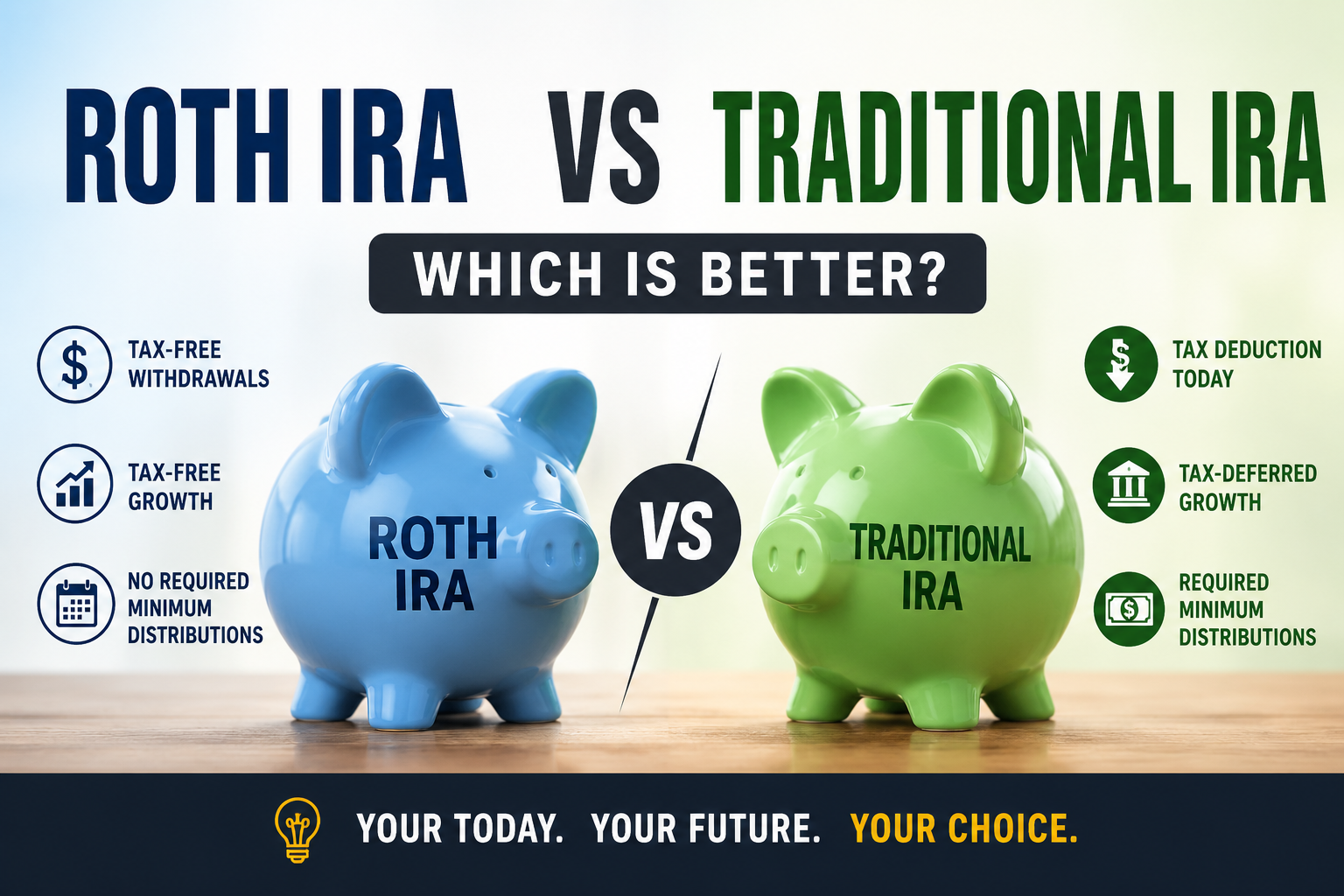

Roth IRA vs. Traditional IRA: Which One Should You Choose?
Planning for retirement is one of the smartest financial decisions you can make. If you’re looking to build long-term wealth while enjoying tax advantages, you’ve probably come across two popular retirement accounts: the Roth IRA and the Traditional IRA.
Although both help you save for retirement, they work very differently when it comes to taxes, withdrawals, and eligibility.
In this guide, we’ll break down the key differences so you can confidently choose the account that best fits your financial future.
What Is a Traditional IRA?
A Traditional Individual Retirement Account (IRA) allows you to contribute pre-tax or tax-deductible money (depending on your income and whether you’re covered by a workplace retirement plan).
Your investments grow tax-deferred, meaning you won’t pay taxes on investment gains until you withdraw money during retirement.
Benefits
- Potential tax deduction on contributions
- Investments grow tax-deferred
- Lower taxable income today
- Ideal for people expecting a lower tax bracket in retirement
Drawbacks
- Withdrawals are taxed as ordinary income
- Required Minimum Distributions (RMDs) begin later in retirement
- Early withdrawals before age 59½ may trigger taxes and penalties
What Is a Roth IRA?
A Roth IRA is funded with after-tax dollars. Since you’ve already paid taxes on your contributions, qualified withdrawals during retirement are completely tax-free.
This makes Roth IRAs especially attractive for younger investors or anyone expecting higher tax rates in the future.
Benefits
- Tax-free retirement withdrawals
- No Required Minimum Distributions (RMDs) during your lifetime
- Tax-free investment growth
- Contributions (not earnings) can generally be withdrawn anytime without taxes or penalties
Drawbacks
- No immediate tax deduction
- Income limits may restrict eligibility
- Contributions are made with after-tax dollars
Roth IRA vs. Traditional IRA: Side-by-Side Comparison
| Feature | Roth IRA | Traditional IRA |
|---|---|---|
| Contributions | After-tax dollars | Pre-tax or tax-deductible |
| Tax Benefit | Tax-free withdrawals | Tax deduction today |
| Investment Growth | Tax-free | Tax-deferred |
| Retirement Withdrawals | Tax-free (qualified) | Taxable |
| Required Minimum Distributions | None during owner’s lifetime | Yes |
| Income Limits | Yes | No limit to contribute (deduction rules may apply) |
| Best For | Younger earners, higher future tax bracket | Higher earners seeking current tax savings |
Which IRA Is Better?
The answer depends on your current financial situation and future expectations.
Choose a Roth IRA if:
- You’re early in your career.
- Your current income is relatively low.
- You expect your income (and tax bracket) to increase over time.
- You want tax-free income during retirement.
- You want to avoid Required Minimum Distributions.
Choose a Traditional IRA if:
- You want a tax deduction today.
- You’re currently in a high tax bracket.
- You expect to be in a lower tax bracket after retirement.
- You want to reduce your taxable income this year.
Can You Have Both?
Yes.
Many investors contribute to both a Traditional IRA and a Roth IRA if they qualify. This strategy creates tax diversification, giving you more flexibility when withdrawing money in retirement.
Keep in mind that the IRS sets an annual combined contribution limit across all your IRAs.
Common Mistakes to Avoid
- Waiting too long to start investing
- Ignoring contribution limits
- Forgetting about income eligibility rules for Roth IRAs
- Withdrawing retirement funds early
- Choosing an account based solely on today’s tax savings instead of long-term goals
Frequently Asked Questions
Is a Roth IRA always better?
Not necessarily. It depends on whether paying taxes now or later is more beneficial for your financial situation.
Can I convert a Traditional IRA into a Roth IRA?
Yes. This process is called a Roth conversion. However, you’ll generally owe income taxes on the amount converted.
Which IRA is best for beginners?
For many younger investors with decades before retirement, a Roth IRA is often an attractive option because of its tax-free growth and withdrawals. However, every investor’s situation is unique.
Final Thoughts
Both Roth IRAs and Traditional IRAs are excellent retirement savings tools. The best choice depends on your current income, tax bracket, retirement timeline, and long-term financial goals.
If you believe your taxes will be higher in retirement, a Roth IRA may provide greater long-term value. If you’re looking to lower your taxable income today, a Traditional IRA could be the smarter choice.
